Fiscalization in Albania is the process by which every invoice is sent to the tax administration’s system at the moment it is issued and receives the NIVF (fiscal invoice number) identification number from the platform. It is governed by law 87/2019, has applied since 2021 and in 2026 is supplemented by the POS/POI obligation and the new limits on cash payments.
What fiscalization is in Albania
Fiscalization is the taxpayer’s obligation to report every invoice to the electronic system of the General Directorate of Taxes (DPT) at the moment of issue. Before the reform, invoices were not verified by the administration when they were issued; with fiscalization, every invoice passes in real time through the Central Invoice Platform (Council of Ministers Decision, VKM, no. 431/2020), where it is verified and assigned its unique identification number.
The legal basis is law no. 87/2019, dated 18 December 2019, “Për faturën dhe sistemin e monitorimit të qarkullimit” (On the invoice and the circulation monitoring system), published in the Official Gazette no. 3 on 20 January 2020 and amended by laws no. 108/2020 and no. 83/2025. The law governs the fiscalization of invoices for supplies of goods and services and of the accompanying invoice (fatura shoqëruese), the exchange format (XML under the UN/CEFACT and UBL 2.1 standards), the advanced electronic signature and the exchange of data with the administration. With the 2025 amendments, non-profit organizations and political parties have also become invoice issuers.
How invoice fiscalization works, step by step
- The business issues the invoice from certified software or, when it meets the conditions, from the SelfCare portal; the software generates the invoice issuer security code (NSLF) for the invoice, a unique alphanumeric code (Article 3 of law 87/2019).
- The invoice is signed with an advanced electronic signature using the business’s certificate and sent immediately to the Central Invoice Platform.
- The DPT system verifies the invoice and returns as confirmation the unique invoice identification number (NIVF), which is recorded as the invoice’s main data item.
- For cash sales, the invoice is printed and handed to the customer with the QR code; payment by debit or credit card is treated as a cash payment, so it is fiscalized in the same way.
- The business also keeps the invoices as digital copies; storage in the cloud is allowed.
The DPT’s SelfCare portal (efiskalizimi-app.tatime.gov.al/self-care/) works in the browser, with no installation, and you sign in with the business’s e-Albania account. Issuing invoices from it is free, but only for the categories in VKM no. 220/2020: the self-employed individual working alone, not registered for VAT and with a single place of business, and public bodies. Other businesses invoice with software certified under VKM no. 239/2020.
Fiscalization deadlines: who joined when
Fiscalization was introduced in phases during 2021; in 2026 the obligation for POS/POI card payment terminals was added, set by Article 59/3 of law no. 9920/2008 “Për procedurat tatimore” (On tax procedures):
| Phase | Taxpayers | Applies from |
|---|---|---|
| Non-cash invoices to public institutions (B2G) | taxpayers that supply the public sector | 1 January 2021 |
| Non-cash invoices between businesses (B2B) | all taxpayers with non-cash invoices | 1 July 2021 |
| Cash sales | taxpayers with electronic fiscal devices | 1 September 2021 |
| POS/POI terminal at every point of sale | accommodation establishments, transport, public institutions and public companies with state capital | 30 May 2026 |
| POS/POI terminal at every point of sale | all other taxpayers with cash sales | 31 December 2026 |
Also from 2026, law no. 79/2025 limited cash payments: up to 100,000 lek between taxpayers and up to 500,000 lek between a business and an individual. We have explained the POS/POI obligation in detail in the guide to the 31 December 2026 deadline (in Albanian).
Exempt from issuing a fiscal invoice (Article 5 of law 87/2019, as amended) are: agricultural producers, with or without the VAT compensation scheme; the sale of tickets or coupons by the driver of a passenger transport vehicle on urban routes; supplies by individuals registered as “ambulantë” (street vendors); and the other cases provided for by VAT legislation.
What a business needs for fiscalization
- The electronic certificate. It is obtained from the National Agency for Information Society (AKSHI) through e-Albania (service code 13691), is valid for 1 year and is renewed by applying at least 30 days before it expires. A single certificate covers all of the business’s devices; invoices are signed with it and sent to the platform.
- Invoicing software. An invoicing, POS or accounting program certified under VKM no. 239/2020, integrated directly with the DPT platform. The SelfCare portal is enough only for the categories that use it free of charge.
- The fiscal device for cash sales. Businesses with cash sales invoice from the electronic invoicing device and print the invoice with the QR code; the POS/POI terminal is added as a separate obligation in 2026.
- A test before you start. The setup and the invoice flow can be tested in the DPT test environment (efiskalizimi-app-test.tatime.gov.al/self-care/) before the first real invoice.
Which fiscalization software to choose
Three criteria carry weight in the choice: certification of the software under VKM no. 239/2020 (without it, the software does not connect to the DPT platform), full coverage of cash sales with QR printing, and integration with accounting, so that you do not enter invoices twice. For the accounting program, see 12 criteria for choosing accounting or ERP software in Albania.
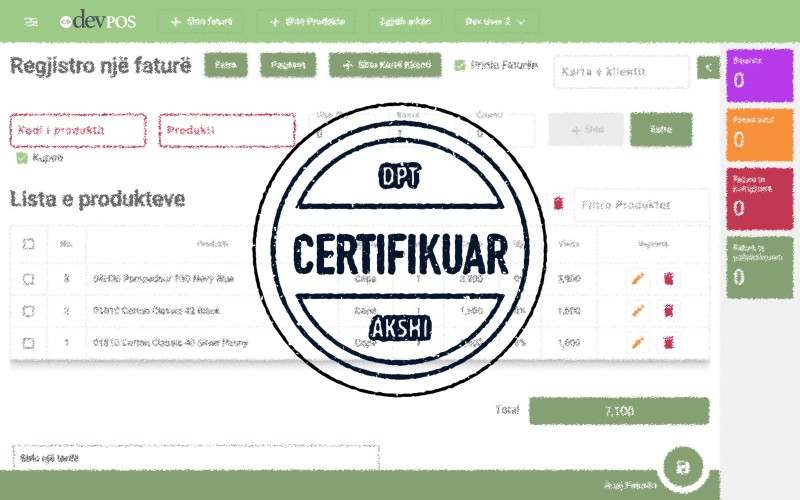
Recommended solution: devPOS, certified fiscalization software from dev.al

The solution we recommend is devPOS, the fiscalization system from dev.al. We say it openly: this blog is run by devBooks, which belongs to the same group. What devPOS offers:
- Certified fiscalization software: it connects to the Central Invoice Platform, generates the NSLF and obtains the NIVF for every invoice, with payments in cash, by card or through the bank.
- Invoicing and till on one screen: recording invoices, returns and payments received at the point of sale, with the invoice printed with the QR code for cash sales.
- Two-way integration with devBooks: purchase and sales invoices from SelfCare are imported automatically into devBooks through devPOS, the payment status is checked from devBooks and changes propagate in real time through the webhook (devBooks integrations).
- Switching from your current program: devBooks clients who use another fiscalization program get devPOS free for the period left on their current contract and then at a 30% discount; devPOS data (master records, invoices and accompanying warehouse documents) is migrated automatically into devBooks (the full plans are on devBooks pricing).
Before you decide, ask each provider to show how it meets the three criteria above, with a real test of the fiscalization flow and not just promises.
Fiscalization offline, corrections and archiving
| Situation | Obligation | Deadline | Legal basis |
|---|---|---|---|
| The internet goes down | the invoice is issued and printed without an NIVF, then sent for fiscalization | within 48 hours of the moment the connection was lost | Article 29 |
| The fiscal device breaks down | invoices from a special invoice pad; the device is repaired or replaced, then the pad invoices are fiscalized | 5 days, plus 5 days for fiscalization | Article 30 |
| An area without internet coverage, certified by the Electronic and Postal Communications Authority (AKEP) | the invoices are submitted to the administration | by the 10th of the following month | Article 31 |
For imported goods, the recipient in Albania fiscalizes the invoice, on the basis of the customs declaration, no later than 7 days after the goods are released for free circulation; the deadline was extended from 3 to 7 days by law no. 83/2025 (Article 20, point 10).
A fiscalized invoice is not cancelled: it is corrected only with a corrective invoice that references the NSLF and the date and time of the original invoice (Article 32). The buyer can verify the invoice within 60 days of issue, through the QR code, the central platform or at the tax administration’s offices (Article 35). Invoices are kept in digital form for the period set by accounting legislation.
Fiscalization fines in Albania
The fines are set in law no. 9920/2008 on tax procedures, as amended:
| Violation | Sanction | Legal basis |
|---|---|---|
| Failure to issue an invoice | 25,000, 50,000 or 75,000 ALL depending on the tax regime; not less than the missing VAT | Article 123, point 1 |
| Failure to issue an invoice a second time within the calendar year, found both times during an on-site inspection | in addition to the fine in point 1: a further fine of 50,000, 100,000 or 500,000 ALL; tax assessment by alternative methods for the last three months (VAT-registered taxpayers); 30-day suspension of business activity | Article 123, point 3 |
| Failure to issue an invoice a third time within the year | criminal prosecution and publication of the name and NIPT (tax ID) on the DPT website | Article 123, point 4 |
| Fiscalization violations, including not having the electronic invoicing device for cash payments | 25,000, 50,000 or 75,000 ALL depending on the tax regime | Article 124 |
| Failure to issue or send the e-invoice (B2B and B2G) | 50,000, 100,000 or 150,000 ALL depending on the tax regime | Article 124/2 |
| A software producer or maintainer that, when fiscal devices are confiscated, does not cooperate with the tax administration to open or verify them | 1,000,000 ALL | Article 124/1, point 3 (added by law no. 79/2025) |
Sources
- Law no. 87/2019, dated 18.12.2019 (official text on QBZ, the Official Publications Centre)
- Law no. 87/2019 as amended (consolidated text from the DPT)
- DPT: Fiscalization (devices, certification and specifications)
- Law no. 9920/2008, consolidated (Articles 123 and 124)
- Law no. 79/2025 (limits on cash payments)
- DPT: POS/POI terminals, 31 December 2026 is the final deadline
- The DPT’s SelfCare portal (Central Invoice Platform)
- DPT: Notice on how the SelfCare portal works (who uses it free of charge)
- devPOS: certified fiscalization software, dev.al
An expired certificate or uncertified software stops the issuing of fiscal invoices. For fiscalization, try devPOS, the certified system from dev.al integrated with devBooks; for full accounting, see devBooks pricing or write to us for a demo of the process from the invoice to the financial statements.